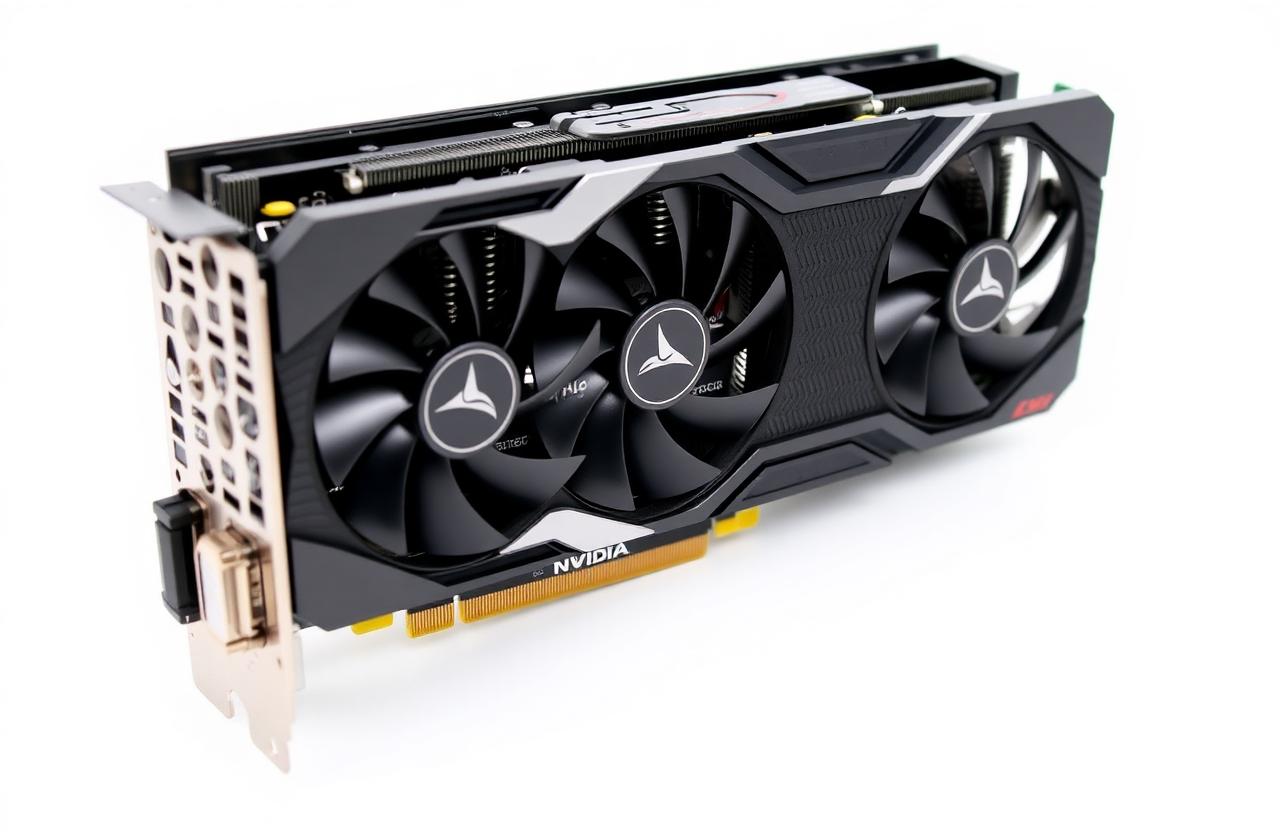
01What a GPU really is
A GPU is a massively parallel processor with thousands of small cores. While a CPU executes a few complex tasks very fast, a GPU executes thousands of simple tasks at the same time — perfect for pixels, vectors and matrices.
02Architecture in 60 seconds
- Streaming Multiprocessors (SM) on NVIDIA / Compute Units (CU) on AMD.
- Each contains dozens of cores (CUDA / Stream Processors).
- Dedicated units for ray tracing (RT cores) and AI (Tensor cores).
- VRAM (GDDR6 / GDDR6X / HBM) feeds the cores at hundreds of GB/s.
03VRAM matters
VRAM stores textures, framebuffers and AI model weights. Running out of VRAM tanks performance, no matter how fast the GPU is.
- 1080p gaming: 8 GB minimum.
- 1440p / light AI: 12 GB.
- 4K / serious AI: 16–24 GB.
- Large LLMs: 24 GB+ or multi-GPU.
04Ray tracing and DLSS / FSR
Ray tracing simulates light bouncing realistically — gorgeous but expensive. Upscalers like DLSS, FSR and XeSS render at lower resolution and reconstruct, recovering most of the lost performance.
05GPUs for AI
The same massively parallel architecture is ideal for matrix math used in neural networks. Tensor cores accelerate FP16/INT8 operations 5–10×, making consumer GPUs viable for training small models and running inference on large ones.
06Choosing a GPU
- Match GPU to monitor: don't pair a 4K screen with an entry-level card.
- Check PSU wattage and PCIe power connectors.
- Ensure case clearance — modern GPUs are 30+ cm long.
- Driver maturity matters: stick with current generations.